In one of our experiments, we tested two ways for a small learning agent to carry experience forward. Across the test runs, each correctly repeated all 64 old tasks. On 128 new tasks that combined earlier skills, one solved six and the other solved 98. One kept its initial set of preferred building blocks; the other added components from new solutions.
Passing the recall test told us that old solutions were still available. It told us much less about whether the agent could use their structure to find a new solution.
We study this problem at FriendMachine as part of our work on learning agents. A related gap appeared in Better models, same behavior, where agents learned more accurate models of their surroundings without reliably acting better. The experiments here use a different kind of agent, one that learns procedures for transforming lists of numbers. They let us examine a specific link between knowledge and behavior: how remembered procedures change what the agent tries next.
The useful finding is that a memory can help solve a new problem while also becoming an expensive bias. Giving familiar solutions a limited opportunity, followed by a broader search, improved results in some conditions. How much it helped depended strongly on the problems that followed. Simpler ways to reuse parts of old solutions were often stronger still.
What the agent learns
The tasks are deliberately small. An agent might see that the list [2, −1] becomes [2, 2, −1, −1], and that [3] becomes [3, 3]. It has to find a procedure that explains the examples, then apply it to inputs it has not seen.
We supply a language of operations and rules for combining them. Earlier versions could reverse a list, sort it, filter it or change its values, with repetition controlled by arguments or features of the input. A later version adds loops that can emit values into a new list. The learner searches for combinations of these operations; we do not give it the target procedure.
An acquired procedure can be stored and called again. Its components can also become building blocks for later search. The agent retains the examples it actually observed and may request more, up to a fixed allowance. A candidate that fits its observations still has to face separate tests, including longer lists and changed patterns of values.
This gives us several distinct questions. Can the agent recall an old solution? Can it combine what it learned into a new one? Does giving remembered structure priority make that search better? The perfect recall scores answered only the first.
Memory changes which possibilities get tried
Consider an agent that has learned several useful procedures. A reasonable strategy is to try combinations of those procedures before constructing a solution from more general operations. When the next problem shares their structure, this can save a great deal of work.
The difficulty is that the agent does not know in advance whether the next problem is related. It can spend its allowance combining familiar procedures while a simpler explanation waits elsewhere in the search. The same memory then makes a useful possibility harder to reach.
We tested a simple limit on that priority. The agent could spend at most 50,000 counted operations trying remembered procedures, within a total allowance of 300,000. If it had not found a solution, ordinary search received the remaining allowance. The ordinary-search comparison used the same language and starting experience. Both could eventually express the same solutions; memory changed the order in which possibilities were tried.
For the main mixture experiment, 16 fresh learners first acquired procedures from examples. We then restored each learner’s acquired state into every comparison and gave it actual sequences of 16 new tasks. Some tasks combined functions from its earlier curriculum. Others were generated independently within the supplied language. We varied the related fraction from none to all, in steps of a quarter. The learner was never told which group a task belonged to.
With half the tasks related, limited whole-procedure reuse solved 153 of 256 tasks, against 131 for ordinary search: about 60% versus 51%. The paired 95% interval for the gain was 6.3 to 11.3 percentage points. It used about 25% less counted work after including the cost of acquiring the initial procedures. It also requested 190 additional example answers across those tasks. That added information is part of the policy’s cost and possible benefit.
With every task related, success rose from 209 to 254 out of 256. With no related tasks, both policies solved 55, while limited reuse did more work. Equal scores on that panel do not establish that the policies are generally equivalent.
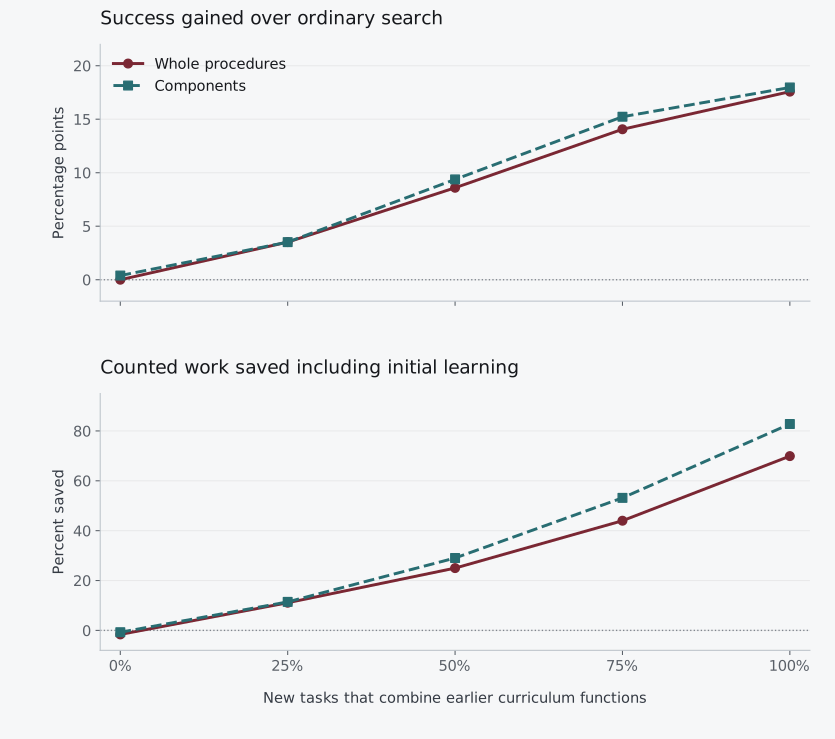
The experiment’s primary question concerned whether reuse’s advantage in search work, after initial learning, changed between related and independent streams. That difference held up across learners. The accuracy comparisons are secondary results. The pattern supports a conditional benefit: a search priority can be useful in one stream and an expense in another.
More priority did not automatically help. Doubling the remembered-procedure allowance from 50,000 to 100,000 used more work at every tested mixture and increased none of the success counts. These settings were chosen by us. The agent has not learned how much authority to give its memory.
Smaller pieces were a strong comparison
Whole procedures were not the only way to carry experience forward. We also let the agent reuse components of procedures it had actually acquired, under the same 50,000-operation allowance.
This simpler comparison used less work at every measured mixture, and its success counts matched or exceeded whole-procedure reuse. The small accuracy differences did not establish that components were more accurate. The work results do limit how much credit we can give to remembering whole procedures as a special mechanism. Much of the benefit was available through conventional reuse of useful parts.
The all-related result also shows why a success percentage can hide a decision that matters. Component reuse produced 255 successes and one accepted solution that failed the separate tests. Whole-procedure reuse produced 254 successes, no accepted failures and two occasions where it returned no solution.
Which outcome is preferable depends on what happens after an error or a refusal. A wrong answer that is acted on can be more costly than asking for help. The cheaper method with the higher success count may still be a poor choice when mistakes are expensive. An agent’s evaluation should retain these outcomes separately, along with the examples and computation it consumes.
Solving now shapes what can be learned for later
There is a second competition for the same resources. While an agent searches for today’s answer, it can also spend effort updating which acquired structures it will prioritize tomorrow.
In an earlier experiment, two versions had the same overall work allowance per task. One allowed more of it to go to immediate solving, leaving less available for updating its reusable knowledge. It solved 26 early tasks against 21 for the version with the smaller immediate-search allowance. On a later set of 128 tasks mixing earlier and newly acquired structure, it solved 29 against 78.
The policies also collected different examples, returned different procedures and followed different learning histories. We have not isolated reduced updating as the sole cause of the later loss. A simpler reuse method was stronger than the richer updating method in this experiment too.
Even with those qualifications, judging only the initial answers would have favored the version that later did much worse. If the purpose of an agent is to keep learning, the value of solving a task includes what the attempt leaves available for future tasks. Immediate success and future preparation need separate measurements.
Some failures require a different language
Search priority cannot solve every failure. Every operation in our original list language preserved or reduced the number of elements. Repeating or combining those operations preserved that property. Duplicating each element was therefore impossible for a nonempty input, however long the agent searched or however well it remembered earlier solutions.
We expanded the language with general loops and emissions. An agent could then construct duplication by emitting each input value twice. Ordinary search and limited reuse both learned that behavior, along with reversed duplication and appending a zero. Another expressible task, swapping neighboring pairs, remained unsolved within the search budget.
These are different obstacles with different remedies. One required us to expand what the agent could express. Another remained a problem of reaching an available explanation. The agents did not invent the larger language; we supplied it with the task definitions visible. On an externally authored collection, ordinary search and limited reuse both passed 352 of 384 supported task instances. That evaluation covered 12 of 23 task names; the other 11 required different input or output types, or additional arguments. The expansion gave all search policies new capabilities, with no observed external accuracy gain from prioritizing memory.
The distinction connects to Where knowing stops. Before spending more on a method, it helps to ask whether the missing answer is one that the method can represent at all.
Larger tests can leave the important question unanswered
Even when the right procedure is available, examples can support the wrong explanation. One saved case from an inquiry experiment involved two procedures that repeated an operation a different number of times. One used the length of the list. The correct one used the number of distinct values.
The wrong procedure passed every longer-list test for that task. Yet on a list containing eight copies of −7, it returned an empty list while the correct procedure left the input unchanged. The repeated values exposed a distinction that larger inputs had missed.
That case illustrates a broader experimental result with narrower statistical support: choosing questions to separate candidate explanations improved a test focused on changed input features, while the main longer-input comparison remained inconclusive. Increasing the size of a test and increasing its power to distinguish explanations are separate choices.
Factorization is a scientific choice makes a related point through an agent testing why a door opens. A useful experiment creates a situation where the remaining explanations predict different observations. Repetition of familiar evidence can leave the crucial disagreement untouched.
What these results support
These are small, deterministic tasks in languages we designed. Related tasks deliberately share curriculum structure, and fresh random runs still come from those restricted distributions. The later mixture experiment used 16 independent learners; its thousands of decisions are not thousands of independent replications. Its uncertainty intervals are paired over learners and are nominal, without a correction across the campaign’s many comparisons. The reported work counts are defined computational operations, not measurements of energy or portable processor time.
We fixed settings and outcomes of interest before the main confirmation runs, checked saved decisions and work accounting, and tested continuity after saving and restoring the learners. Those checks support the internal results. They do not establish general intelligence, a new theory of human memory, or an advantage over established synthesis systems.
What the experiments give us is a sharper question about learning agents. Available knowledge changes the route through a problem, and the route changes which evidence and new knowledge the agent acquires. A useful memory system needs a way to decide when familiar structure deserves priority and when the search should widen.
Our limits on reuse are fixed rules. A stronger next test would let an agent make that allocation from evidence it can actually observe, then face kinds of problem whose design did not shape its language. The cost of making the allocation would count too. That would move us toward the capability we want: carrying experience forward while remaining able to find an explanation that experience did not suggest.