In one of our experiments, a small simulated agent learned to distinguish “moving right worked” from “moving right into a wall left me where I was.” That one distinction cut its prediction error by 52%. In two of the four worlds we then tested it in, it collected goals more slowly than the version without that distinction.
You would expect an agent that understands its world better to act better in it. Our experiments with Embodied Field Intelligence (EFI), a research agent we built at FriendMachine, often found otherwise. A change would improve what the agent had learned, measured by a test built for exactly that, and its behavior over a whole task would stay the same or get worse. The pattern has exceptions, so we walk through five specific cases. Together they point at a central problem for learning systems, which is connecting what a system knows to what it does.
The setup, briefly
EFI lives in small grid worlds of walls, goals and, often, a block it can push. It sees only a 5×5 patch around itself. Instead of a trained neural network, it keeps its beliefs, memories and preferences as values spread across a map of its surroundings, which we call fields. The agent chooses actions by letting those values settle through local updates, in which each cell exchanges values only with its neighbors. Some experiments also let it learn what its own actions do, such as how a block responds when pushed.
Every experiment fixed its success criteria and code in advance and was scored on fresh randomized worlds not used during design. A “seed” identifies one such randomized run. To test whether a piece of learned knowledge was doing the work, we often deleted it and ran again. A change joins the default agent only if it passes a pre-agreed test, which we call a gate. A change can improve its target and still fail its gate because something else got worse.
Five cases
Each case pairs a targeted test of what the agent learned with a broader test of whether it acted better.
Remembering the circumstances
In the experiment from the opening, the agent had learned what its moves did but not whether a wall stood where a move would take it, so successful moves and moves blocked by a wall were stored together. Recording that one condition cut its prediction error by 52% on 40 fresh seeds. The change had costs. Prediction worsened for one response pattern in which commands produce no movement, and early adaptation was slower. In two of four test worlds, both built around the information-gathering task in the third case below, the improved agent collected goals more slowly, in one of them about 0.196 goals per step against 0.225. It was not adopted.
Recalling consequences without retesting
Here the agent stood beside a block and moved it with four commands. The block followed one of several hidden rule sets, each linking commands to block movements, and nothing the agent could see said which set was in force. It learned the rule sets, then met them again later. After a single interaction, its prediction error on commands it had not yet retried was 89% lower than a learner that starts fresh each time, and erasing or scrambling the memories removed much of that benefit. But over a full lifetime of choosing its own actions, this memory has not met its behavioral requirements. A revised version improved some adaptation scores but did not pass its robustness tests and was not adopted.
A preference for gathering information
Unlike the others, this case tests a learned preference rather than prediction accuracy. In a small world, two hidden rules look identical at the start. One “wait and watch” action reveals which is in force, because the block moves left under one rule and right under the other. The agent learned when watching pays, choosing that action about 78% of the time where it helped against about 39% where it didn’t. In continuous play, its average lifetime reward was 86.02, the same as a version that ignored the information (86.02) and a matched random policy (86.07). Those long runs, however, rarely put the agent in the situation the test was built around.
Combining two skills
The agent learned how it moves and how objects respond to contact in separate lessons. It then combined them in an unseen task with two actions to reach a goal covered by a block, one to approach and one to push the block while stepping onto the goal. Here the movement knowledge did help. Success on first attempts was 62.2%, against 57.2% for an earlier version whose movement was supplied rather than learned. But erasing the learned contact knowledge raised success to 65.8%.
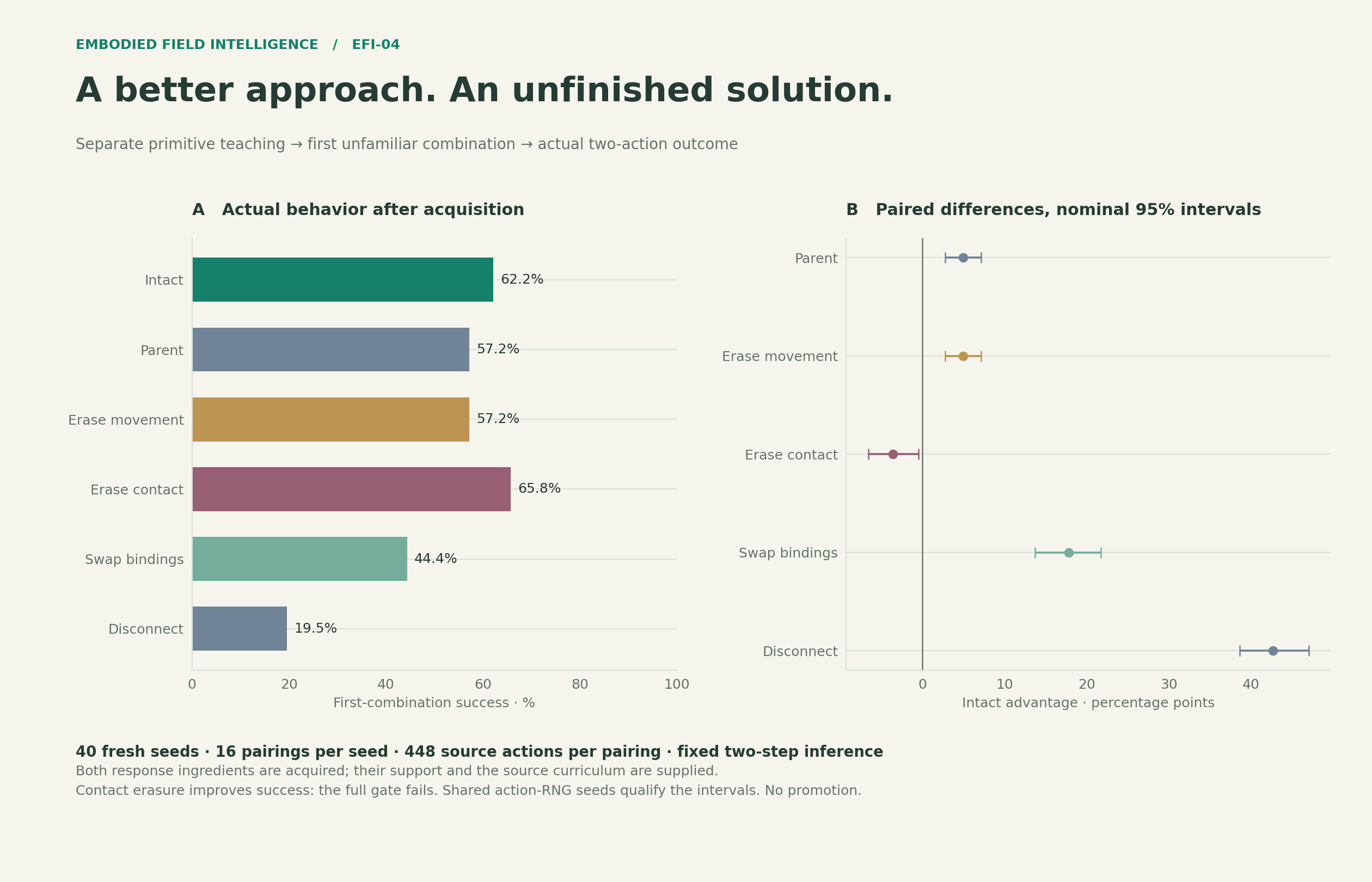
A later audit localized one problem. On its last allowed action the agent still planned two steps ahead, so it could favor a move whose payoff would arrive only after the trial had ended. In a follow-up where that deadline was respected, success rose from 62.8% to 68.6%, and removing contact knowledge cost 2.5 points, the expected direction. But the uncertainty range ran from slightly below zero to +5 points, so the test could not confirm that contact knowledge helps.
Carrying experience into a new world
The last case used eight small worlds, each a different mechanical puzzle for the same body and commands. The agent gained experience in two of them, and in each world we tested whether keeping it beat starting with an empty memory. In one world with unreliable movement and another with a hidden latch, experience helped substantially, adding about 22 completions per hundred tasks in each. In a world called Relay, where collecting a reward reveals a second, farther goal, it hurt. Completion was 56% with experience against 78% without, and a later, stronger version (described next) still did worse with experience (90% against 98%). One plausible reason is that the planner treats any reward as the end of the task, while in Relay the first reward is only a waypoint. The reports do not yet treat that as the confirmed cause.
A gain from changing how the agent acts
The largest gain in this work came from changing how the agent moves rather than what it predicts. The earlier agent gave every command the same score when no object was in view, so it could wander. A version that remembers walls and goals after they go out of view, and is drawn toward remembered goals and unexplored edges, completed 90.6% of tasks across the same eight worlds on fresh seeds, against 65.1% for the original. Its settings were chosen during development rather than learned while acting.
What this suggests
The pattern points to credit assignment, the problem of working out which piece of knowledge, or which action, deserves credit for an outcome, so that learning changes the right thing. In these experiments, learning improves what the agent knows, but nothing tells it which knowledge matters for acting. The link from knowledge to choice is still designed by hand, so better knowledge can feed a choice rule that does not use it well.
This is our reading, and no single experiment proves it. The reports do not identify one cause for any of the behavioral failures. Backpropagation, the method used to train most neural networks, is one widely successful answer to credit assignment. An agent built from local, inspectable updates needs its own answer to the question of how a better model becomes better behavior.
Caveats
None of this shows that EFI’s approach fails. Several targeted capabilities passed their own tests, and the navigation result is a large, verified improvement. The worlds are small and simplified, and many details, such as which sensory and action categories exist, are supplied rather than learned. A failed gate is also not proof of harm. Several failures mean an improvement could not be confirmed within the agreed tolerance, not that the change was certainly worse.
Where fields have been tested, they did not make the difference. The navigation improvement, and a separate one for tracking changing rewards, use fairly classical ideas. A later comparison gave the reward-tracking rules to a field agent and to two conventional agents, one using a lookup table and one using a bounded search. The rules helped all three, and no advantage for the field design was established. The navigation variant has not been compared that way.